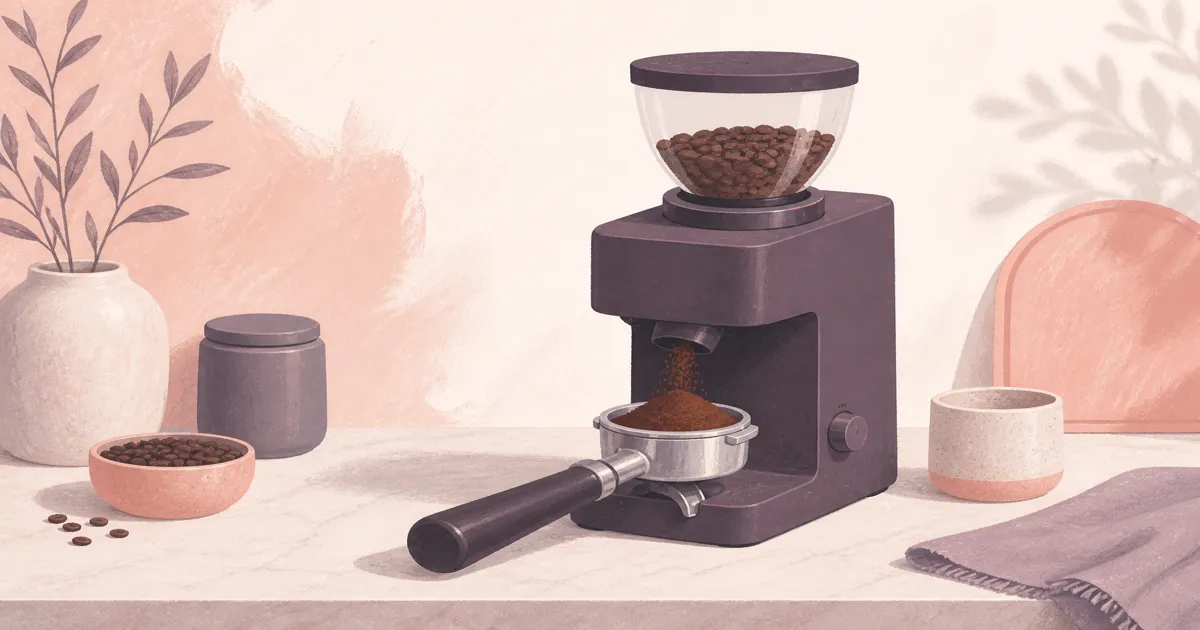
Best Burr Grinder for Espresso: Fine Control Without Cafe Prices
Grinders
Espresso rewards small grind changes. The best burr grinder for espresso gives you fine control, low mess, and settings that do not drift. Here are three picks we would buy on Amazon.
Our picks
Home espresso fails most often at the grinder, not the shiny machine. If particles are uneven or you cannot move a half-step finer, every basket and tamp trick fights the same wall.
This guide covers espresso-capable burr grinders for home counters. It uses grind times and retention numbers from published tests plus our own time at the counter. For general brew matching, see best coffee grinder. Machine context lives in best espresso machine and the beginners guide. Weigh dose and yield on a best espresso scale so grinder changes mean something.
Every espresso grinder guide we publish starts from the same grind-first logic.
Our three espresso grinder picks
Shop: Encore ESP · Baratza Encore · J-Ultra
Best overall: Baratza Encore ESP
The Baratza Encore ESP is the honest entry electric for espresso. It adds about 20 dedicated fine steps to the Encore platform, a front-facing portafilter cradle sized for 54mm baskets, and a pulse button, which together let you dial a Bambino or Gaggia without fighting huge click gaps.
It will not match a $500 single-dose grinder. Retention lands around 1.2g on an 18g dose and can reach 1.6g with oily dark roasts, so single dosing means weighing about 19.2g to land 18g in the basket. Parts support is the long game: the collar, burrs, and even the hopper are service parts, and a replacement collar runs about $12.
Who it is for: Daily doubles, first real espresso kits, and anyone upgrading from a drip-only Encore or a blade unit.
How much does the Encore ESP retain?
About 1.2g on an 18g dose on average, and up to 1.6g with oily beans. That is roughly 6.7% of the dose, so if you single dose, weigh slightly over target. With two doubles a day and $18/lb beans, the coffee that never reaches the cup costs about $0.06 a shot, close to $46 a year.
How do you cut that retention down?
Two spritzes of water on the beans before grinding, the RDT trick, drops measured retention from roughly 2.8g-3.2g to about 1.6g-2.1g and nearly kills the static mess. Purge a few grams when you change beans or settings.
Best filter crossover: Baratza Encore
The Baratza Encore covers filter through occasional espresso with a compact body and lower retention than hopper-heavy mills. If your kitchen also does pour-over most mornings, one mill that can swing both ways is worth the small learning curve.
Give it a week of weighed doses before deciding it cannot do espresso. The narrower fine range is the limit, not the burr.
Who it is for: Mixed brew homes that pull a shot occasionally and want one mill with a long parts life.
Best hand option: 1Zpresso J-Ultra
The 1Zpresso J-Ultra is for people who want espresso-capable adjustment without another motor humming at 6 a.m. Its 48mm heptagonal, titanium-coated burr is tuned for the fine range, and the dial steps just 8 microns per click across 100 clicks a rotation and 5 rotations, so 500 settings in total.
It grinds a double in about 40 to 60 seconds. You pay in forearm time, and a large filter dose needs grinding in stages because the catch cup holds about 35g-40g.
Who it is for: Apartments that hate noise, travel kits, and espresso learners on a quieter budget.
What does espresso actually demand from a grinder?
Espresso pushes water through a packed puck at high pressure. The grind must be fine enough to create resistance and even enough that water does not cut a fast lane through one side. Two specs decide whether a mill can do that: how fine it reaches, and how small its adjustment steps are at the fine end.
Fine range: why a drip grinder stops short
Drip-only mills often stop too coarse for a real espresso basket. On the original Encore, setting 1 was already too coarse for most machines without a pressurized basket. The ESP's reworked burr geometry extends the fine end by roughly 25%, which is what makes genuine espresso possible.
Adjustment resolution: the half-step that fixes a shot
When a shot runs five seconds fast, you need a smaller move than the next click gives you. Huge step gaps are the real problem, not whether the grinder is stepped or stepless. Fine stepped grinders dial in well; coarse steps leave you stuck between a gusher and a choker.
How much coffee does retention waste?
Retention is the coffee left in the grinder after the motor stops. A few tenths of a gram is normal, but a gram or more is a real percentage of a 15g-20g espresso dose. It matters most when you switch beans, switch to decaf, or chase a repeatable 18g dose.
What retention costs you per shot
If you lose 1.2g, you dose about 19.2g to land 18g. At $18/lb, that is around $0.06 a shot, or close to $46 a year at two doubles a day. The Encore ESP and the Specialita are hopper grinders, so they retain more than a dedicated single dose espresso grinder.
What does the Eureka Mignon Specialita retain?
About 1g, a little less than the Encore ESP's roughly 1.2g. Its 55mm flat burrs and sound insulation make it the quieter step-up electric, but the hopper workflow still leaves coffee in the chute, so purge when you change beans.
Does the number on the dial mean anything?
Not across grinders. Eureka applies the Mignon dial mark in a random position at the factory, so "setting 3" on one Specialita is not "3" on another. The number that matters is the distance from true zero, the point where the burrs just begin to chirp. Write your working number down per bag of beans.
That is also why you should run the grinder while adjusting finer. Turning the dial tighter with the motor stopped can jam the burrs, and the manual warns about it. The upside of the design is that the Specialita keeps its grind setting when you lift the top burr carrier out to clean it, so maintenance does not reset your dial-in.
Electric or hand grinder for espresso?
Electric wins for speed and daily doubles. Hand mills win on noise, footprint, and price per unit of grind quality. The deciding question is usually volume: one or two drinks a day is hand-grinder territory, while four drinks in a row turns into a workout.
How long does a hand grinder take?
A 48mm hand burr like the J-Ultra's grinds an 18g espresso dose in about 40 to 60 seconds. A smaller 38mm mill such as the Timemore C3 ESP Pro takes closer to 72 seconds for 17g. For pour-over it is faster on both, because a coarser grind is easier to turn.
Do you need burrs at all for espresso?
Yes. A blade grinder chops beans into a mix of fines and boulders, water finds the easy path, shot time swings, and no dose change fixes it. Every grinder here is conical or flat burr. Skip the cheap blade boxes entirely.
How do you dial in espresso without guesswork?
Use a scale. Dose in, beverage out. Start near a 1:2 ratio in a 25 to 35 second window as a learning lane, then taste. Sour and fast usually wants finer. Bitter, dusty, and slow often wants coarser. Change one thing at a time and write it down.
Channeling, the pale jet streams, wants better distribution and a level tamp as much as a grind change. Keep the basket clean and the dose stable, and let the grinder changes do the rest. Medium roasts forgive beginners; competition light roasts punish a loose workflow, so save those for after your notes look stable.
Static and clumping are the daily annoyances. Fine espresso grounds clump, especially in dry winters, and a tiny spritz of water on the beans or a simple WDT tool evens the puck before you tamp. These habits cost less than another grinder upgrade.
When is your current grinder the limit?
You choke the machine at the finest setting and still run fast when you open one click. You cannot find a middle setting that holds for more than a day. You weigh 18g in and only 15g reaches the basket. Those are grinder problems. Tampers and fancy baskets will not invent resolution that is not there.
If your shots are already tasty and stable, keep the mill. The best burr grinder for espresso is the one that disappears into a boring morning routine.
A pressurized basket can mask a mediocre grind for a while, and that is fine while you learn. When you move to a non-pressurized basket, grinder quality shows up immediately, so plan the purchase order: grinder first or alongside the machine, not as an afterthought. If you are still choosing hardware, the beginner espresso machine guide covers baskets and expectations. Milk texture is separate; see best milk frother when the wand is the bottleneck.
Bottom line
Buy the Baratza Encore ESP for a first electric that can genuinely dial espresso, and accept the roughly 1.2g retention and the lack of a timer. Buy the Baratza Encore if filter coffee is the main job and espresso is occasional. Buy the 1Zpresso J-Ultra if you want precise espresso grinding by hand with almost no retention and no motor noise.
After the grinder is stable, a matching espresso tamper and a simple knock box keep the counter usable. If you want timed dosing on a faster Baratza, see the Baratza Sette 270. Shopping a hard budget? See best espresso grinder under $500. More reading sits on the blog. The homepage is the map back to machines and accessories.
Frequently Asked Questions
What makes the best burr grinder for espresso different from a drip grinder?
Espresso needs finer particles and tighter adjustment. Many drip grinders cannot go fine enough, or they jump too far between clicks. The Baratza Encore ESP is built for that finer range.
Flat or conical burrs for home espresso?
Both can make great shots. Conical models are common in home espresso kits. Judge alignment, adjustment, and workflow rather than the brand name.
How important is stepless adjustment?
Helpful, not magic. Stepped grinders with fine increments can dial in well. Huge step gaps are the real problem.
Can one grinder do espresso and pour-over?
Some can, including the Baratza Encore. Expect compromises: slower filter grinding, more cleaning when you swing between settings, or average results at one end. Dedicated espresso focus is simpler if shots are daily.
Why do my shots swing day to day on the same setting?
Beans age, humidity shifts, and retention mixes old grounds. Weigh dose, purge stale grounds, and nudge grind in small moves.
Is the Baratza Encore ESP worth it for a first espresso setup?
Yes, if you want fine adjustment and parts support without paying for a premium single-dose mill. A blade grinder chops unevenly, and the Encore ESP gives you the small steps espresso needs.
How often should I clean an espresso grinder?
Clean the burr chamber and chute on a schedule, and purge a little coffee when you change beans. Old grounds left in the grinder flavor the next dose, so this habit keeps shots tasting consistent.