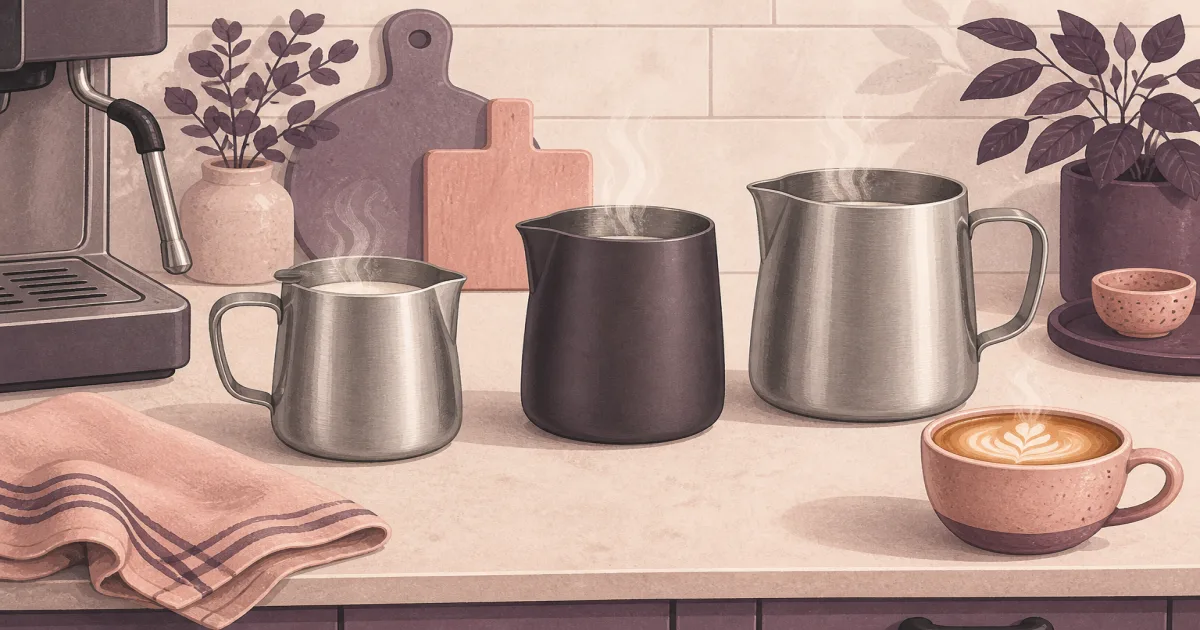
Best Milk Frothing Pitcher (2026): Three Sizes That Make Sense
Accessories
The best milk pitcher fits the amount you steam and gives you enough room to build a whirlpool. These three picks cover a first 12 oz jug, a handleless latte-art upgrade, and a larger pitcher for two drinks.
Our picks
A milk pitcher looks simple, but the wrong size makes steaming harder than it needs to be. Too much empty space and a small home wand never starts a whirlpool. Too little space and expanding milk hits the rim before it is hot enough to pour.
Buy for the drink you actually make. One cappuccino wants a 12 oz jug. A medium latte wants a little more room. Two drinks at once wants 20 oz, and a wand strong enough to spin that volume.
If you are still learning the technique, read our guide to steaming milk at home alongside this comparison. The pitcher helps, but steam position and timing create the texture. For the rest of the counter kit, the espresso accessory guides and the accessories worth buying first list are the next step.
What size milk pitcher should you buy?
Match the pitcher to the milk you steam, not to the coffee you drink. One cappuccino wants a 12 oz jug with about 4 to 6 oz of cold milk. Two drinks want a 20 oz jug. Oversizing is the most common mistake on a small wand.
The cold-milk numbers that matter
A 12 oz pitcher is at its best with 4 to 6 oz of cold milk. A 15 oz pitcher wants about 6 to 8 oz. A 20 oz pitcher wants 8 to 10 oz. Milk roughly doubles as air goes in, so those doses still leave room for the roll.
Start near the base of the spout, never past the halfway mark. If milk reaches the rim while you steam, you used too much or you need a larger pitcher.
Why a bigger jug can make worse foam
A home steam wand is not a cafe wand. It needs the milk close to the tip so air and heat move together. A 20 oz pitcher with only 4 oz of milk gives the wand too much open space, so the milk never spins and you get big bubbles instead of microfoam. In that setup, two smaller batches beat one big one.
Which milk pitcher should you buy?
All three picks use food-grade stainless, and all three pour. The differences are capacity, spout, and how the pitcher feels in the hand. Here is how they line up at today's US prices.
Best for most beginners: Zulay 12 oz milk frothing pitcher
The Zulay 12 oz stainless steel pitcher is the sensible first buy if you steam one cappuccino or a smaller latte. The handle feels familiar. Internal marks give you a repeatable starting amount, and the narrow spout is what lets a beginner pour a heart rather than a blob.
Twelve ounces is the pitcher size, not the milk dose. Milk expands as air goes in. Start near the base of the spout so the volume has somewhere to grow. That smaller working amount matches the steam on many compact home machines.
Choose the Zulay if you make one milk drink at a time and want to learn without paying for a specialized latte-art jug. Skip it if your normal order is two large lattes. Splitting the work into two batches is possible, but a larger pitcher will be faster.
Check price: Zulay 12 oz milk frothing pitcher on Amazon
Best for latte art practice: Normcore 15.2 oz handleless pitcher
The Normcore handleless milk pitcher is the focused choice once your microfoam is already smooth and you want better control while pouring. A silicone sleeve wraps the body, so you hold the pitcher itself instead of a fixed handle. You can rotate into a comfortable angle and feel the steel heat up as the milk comes to temperature. It weighs about 215 grams, and the body is 1mm stainless with a Teflon coating.
Its 15.2 oz capacity sits between the other picks. There is room for a medium latte without making the pitcher feel oversized for a single drink. The round spout favors broad, flowing patterns such as hearts and tulips. It does not create latte art by itself. It gives a practiced pour a predictable edge.
Two maintenance notes. The coated body is not dishwasher safe, so wash it by hand. And back-to-back pitchers can make the exposed steel feel hot through the sleeve, which is the trade for feeling the milk at all.
Choose the Normcore after milk texture is reasonably consistent. It is harder to justify if you only want hot milk under a thick cap of foam. Our milk frother guide covers simpler ways to add foam without using an espresso steam wand.
Check price: Normcore 15.2 oz handleless milk pitcher on Amazon
Best for two drinks: ENLOY 20 oz milk frothing pitcher
The ENLOY 20 oz stainless steel pitcher gives a larger milk dose enough room to expand. It is the pick for a household that regularly makes two cappuccinos back to back, or one large latte that crowds a 12 oz jug.
Capacity only helps if the machine can move that much milk. A compact single-boiler or thermoblock machine may take longer to heat a large batch, and weak steam can struggle to form a strong whirlpool. In that setup, two smaller batches often produce better texture. Machines with stronger steam have an easier time using the extra space.
The handle and pointed spout feel like a cafe jug, which is useful if you already know that grip. Make sure you order the 20 oz size. Photos on a product page can show more than one capacity.
Choose the ENLOY if the 12 oz pitcher overflows during your normal drink routine. Skip it for a single traditional cappuccino. A pitcher that is too large for the milk dose makes it harder to keep the steam tip in the right place.
Check price: ENLOY 20 oz milk frothing pitcher on Amazon
Does the spout shape matter?
Less than milk texture and pouring height, but it is not nothing. A round or wide spout releases a broader stream and suits hearts and simple tulips. A sharp or pointed spout narrows the stream for fine lines and small detail, which only helps once your foam is already glossy.
Round spout or sharp spout
Beginners should not overthink this. Start the pour higher to mix milk into the espresso, then bring the pitcher close to the surface when you want the white pattern to appear. Glossy, paint-like microfoam matters more than the final few millimeters of spout shape.
Is a handleless pitcher better for latte art?
Not automatically. A handleless pitcher lets you grip closer to the balance point and feel the milk temperature through the steel, which helps with fine adjustments. A handled pitcher pours equally well once you know your grip. Pick the one that feels secure when it is wet and full, not the one a video used.
Can I put a stainless pitcher in the dishwasher?
Plain stainless pitchers usually can. Coated or colored bodies and silicone sleeves often cannot, and the Normcore handleless pitcher is explicitly not dishwasher safe. Check the listing for the exact model, and hand wash anything with a coating or a sleeve.
Cleaning without wrecking the finish
Rinse with hot water as soon as you finish pouring, before milk dries around the spout and the handle weld. Hand wash a coated body with a soft sponge, not a scouring pad, and keep silicone sleeves away from harsh detergent so they stay flexible. A thirty-second rinse beats a ten-minute soak every time.
How much does a pitcher cost per drink?
A pitcher is a one-time buy, so the cost per drink is small. The ENLOY 20 oz at about $9.70 works out to under 3 cents a drink over a year of daily milk drinks. The Zulay 12 oz is in the same range, and both cost less than one cafe latte.
The Normcore at $24.41 is the only one with a real price premium, and it buys control rather than capacity. That is worth it only if you are already chasing patterns.
A simple first-use routine
Rinse the new pitcher before use. Add cold milk to around the base of the spout, purge condensation from the steam wand, and place the tip just below the surface. Introduce a little air early, then lower the tip enough to keep the milk rolling without loud screeching.
Stop before the milk becomes too hot to taste sweet, around 150 to 160 degrees Fahrenheit. Wipe and purge the steam wand immediately. Swirl the pitcher to keep the milk and foam together, tap out large bubbles, and pour without waiting.
Clean the pitcher as soon as you finish. Dried milk hides around the spout and handle welds. Plain stainless steel is forgiving, while coated bodies and sleeves should be washed by hand.
Which milk frothing pitcher should you buy?
Buy the Zulay 12 oz pitcher if this is your first steam-wand setup and you make one drink at a time. It is affordable, easy to understand, and sized for a typical home wand.
Buy the Normcore 15.2 oz handleless pitcher if your milk texture is already improving and you want more freedom during pours. The sleeve, round spout, and medium capacity make it the specialist of the group.
Buy the ENLOY 20 oz pitcher if your current jug runs out of room when you steam for two. Make sure your machine has enough steam power before moving to a larger volume.
For the rest of a milk-drink setup, compare our best espresso machines for latte and espresso cups. One well-sized pitcher and consistent technique are enough. You do not need a shelf full of nearly identical jugs.
Frequently Asked Questions
What size milk frothing pitcher should I buy?
A 12 oz pitcher is the easiest starting point for one cappuccino or a smaller latte. Choose 15 to 20 oz when you make a larger drink or steam for two small drinks at once.
How full should a milk pitcher be before steaming?
Start with cold milk near the bottom of the spout, usually around one-third to one-half full. That is about 4 to 6 oz in a 12 oz pitcher and 8 to 10 oz in a 20 oz pitcher.
Is a handleless milk pitcher better for latte art?
Not automatically. A handleless pitcher lets you rotate your grip and feel temperature through the sleeve, but a handled pitcher can pour equally good patterns with practice.
Does the spout shape matter?
A rounder spout makes broad pours and hearts approachable. A sharper spout can give more control for fine lines, but milk texture and pouring height matter more for beginners.
Can I put a stainless milk pitcher in the dishwasher?
Plain stainless pitchers are often dishwasher safe, but colored coatings and silicone sleeves may need hand washing. The Normcore handleless pitcher is not dishwasher safe, so wash it by hand.
Why does my milk not spin in the pitcher?
Either there is too much milk for your wand, or the tip is too deep. Use less milk, keep the tip near the surface at first, then lower it to roll a whirlpool.