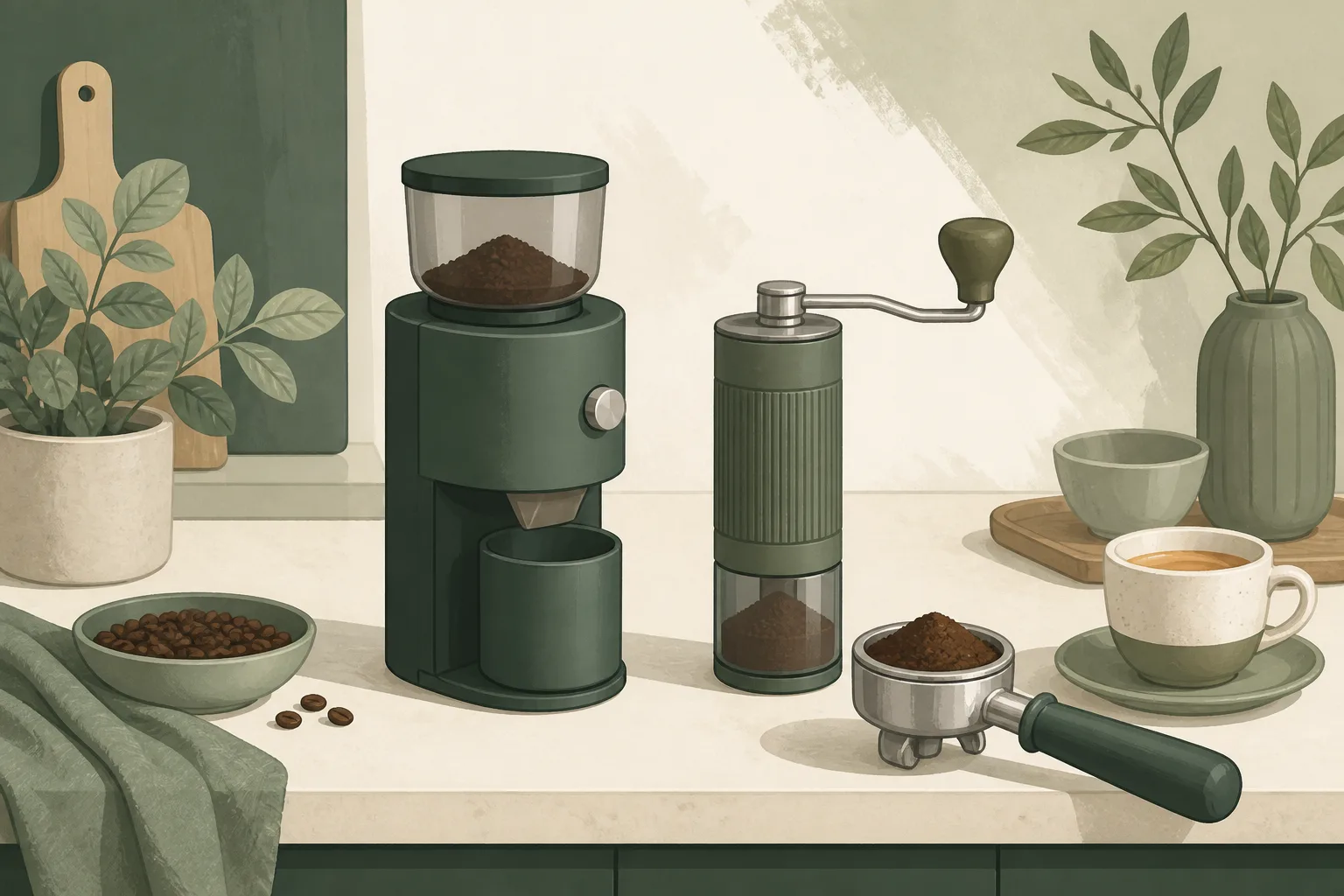
Best Espresso Grinder Under $1,000 (2026): Encore ESP, Specialita, Hand
Grinders
Under $1,000, three grinders earn the spend: Baratza Encore ESP for first electric, Eureka Specialita for quieter flat-burr dosing, Timemore C3 ESP Pro for quiet hand grinding.
Our picks
Shopping for the best espresso grinder under $1,000 usually means three names keep coming up: Baratza for first electric, Eureka for quieter flat-burr dosing, and Timemore for quiet hand grinding. This ceiling is the boundary where prosumer flat-burr work begins, so it is where most home setups stop. There are good reasons it is a popular stop.
Browse more options in our coffee grinder guides. For the broader burr primer, start with the best burr grinder for espresso pillar. Under $500 lives separately in the best espresso grinder under $500 guide.
Start with what is annoying now. If shots jump from choking to gushing, you need smaller adjustment steps. If old coffee lands in every new dose, retention matters. If you wake roommates, a quieter electric or a hand mill may matter more than a larger burr.
What extra money actually buys
An entry espresso grinder can make very good coffee. The important part is that it reaches espresso fineness and moves in small enough steps. A grinder that jumps from choking the machine to running too fast is not fun, even if the box says it handles espresso.
As the budget rises, you tend to get more control over three things:
- Adjustment: Smaller or stepless changes make it easier to land on a good shot time.
- Retention: Less leftover coffee means cleaner results when you switch beans.
- Workflow: Quieter motors, timed doses, easier cleaning, and less mess can make daily use calmer.
Those improvements are useful. They are not automatic proof that an expensive grinder will make every coffee taste better. Fresh beans, a stable recipe, and a clean burr chamber still do most of the work.
Adjustment resolution: the spec that fixes a shot
Resolution is how small a grind change you can make. A stepless mill or a fine-stepped one lets you correct a shot that runs five seconds fast. A coarse-stepped mill leaves you choosing between a gusher and a choker, and no dose tweak fixes that. This is the first thing money buys.
Retention: what a gram of stale coffee costs
Retention is the coffee left inside after the motor stops. At around 1g to 1.2g on an 18g dose, you are losing roughly 6% of the coffee you weighed. If you switch beans or decaf, that carryover lands in the next cup. Purge a few grams, or single-dose into a mill built for it.
The three picks at a glance
Shop: Baratza Encore ESP · Eureka Mignon Specialita · Timemore C3 ESP Pro
Best entry electric: Baratza Encore ESP
The Baratza Encore ESP is the entry electric we would look at first under this ceiling. Its fine adjustment range is built around espresso, with a separate coarser half for filter coffee. The portafilter cradle and front pulse button make weekday doubles less fiddly.
It is not a silent, zero-retention luxury machine. Hopper grinders leave coffee in the chute. Purge a little when you change beans, and brush the burrs on a regular schedule. The trade is serviceable parts and a mill that lets a home setup get serious without burning the whole budget.
Choose it if you want electric speed, mixed brew methods, and a grinder you can actually take apart. Skip it if you already know you want a true single-dose workflow. That path is in our single dose espresso grinder guide.
Shop: Baratza Encore ESP on Amazon
Best quiet electric: Eureka Mignon Specialita
The Eureka Mignon Specialita is the step-up electric when the Encore's steps feel coarse and motor noise is getting old. Timed doses help you repeat a double without watching the button, and the quieter housing is kinder in apartments.
It is still a hopper-style workflow unless you single-dose into the throat. Retention is better than many entry mills at around 1g, but it is not a bellows single-dose box. Always run the grinder while adjusting finer, because turning the dial tight with the motor stopped can jam the burrs. Buy it when espresso is the main job and you want a compact flat-burr mill that still fits under this ceiling. For a deeper named review, see Eureka Mignon Specialita.
Compared with the Baratza Sette 270 from our under $500 espresso grinder guide, the Specialita is the quieter, flat-burr step up at the cost of less timed-dose speed. If speed and timed dosing matter more than quiet, the Sette 270 is the better buy. If quiet mornings and a flatter cup profile matter more, the Specialita earns the jump.
Shop: Eureka Mignon Specialita on Amazon
Best quiet hand: Timemore C3 ESP Pro
The Timemore C3 ESP Pro is the quiet alternative. Its espresso-leaning adjustment lets you make small changes, and it does not wake the kitchen with a motor. One or two daily shots is the sweet spot, and the 20g catch cup sets that limit.
The trade is physical effort. Grinding for four cappuccinos while guests wait gets old. It stores in a drawer, which is the apartment win: no second motor on the counter, and no 6 a.m. burr noise through a thin wall.
Choose it if quiet mornings and compact storage matter more than speed. Skip it if espresso is a guest-round hobby every weekend.
Shop: Timemore C3 ESP Pro on Amazon
Do I need burrs at all?
Yes, if you want espresso. A blade grinder is not a serious espresso tool. It chops beans into a mix of fines and boulders, water finds the easiest path through, your shot runs fast and sour, and you cannot fix it by changing the dose. Every grinder on this page is a conical or flat burr grinder for that reason. The Encore ESP and Specialita use different burr geometries; the C3 ESP Pro is a conical hand mill. Pick any of them and skip the cheap blade boxes.
Why a blade grinder cannot hold an espresso grind
Espresso needs a narrow band of particle sizes, and a blade produces everything at once. A 38mm-55mm burr set crushes beans between two cutting surfaces, which is why it repeats the same distribution dose after dose. That repeatability is what lets you dial a recipe and return to it.
Hopper or single dose?
A hopper grinder holds several days of beans. It is convenient when you drink one coffee repeatedly. Add beans, turn it on, and grind into the portafilter. The downside is that coffee can sit in the chute and hopper, especially if your house is warm or you drink slowly.
Single dosing means you weigh a dose before each shot and put only that coffee in the grinder. It is cleaner for switching between coffees and reduces stale leftovers. It also adds a small step to every drink.
Neither is universally better. A hopper is sensible for a household that makes the same medium roast every morning. Single dosing is better if you like decaf after dinner, change roasts frequently, or care about a very repeatable 18-gram dose. Our single dose espresso grinder guide covers that path in detail.
Which workflow fits a weekday?
A hopper wins if you drink one coffee and want a fast double before work. Single dosing wins if you change beans or decaf often, because nothing stale carries over. If you are honest that you will never weigh a dose in the morning, buy the hopper mill and skip the ceremony.
Flat burrs, conical burrs, and useful questions
Flat and conical burrs can both make excellent home espresso. The shape alone does not decide whether a grinder is right for you. Alignment, adjustment, build quality, and the coffee you like matter more.
Instead of arguing about burr geometry, ask:
- Can it make a small enough grind change for my machine?
- Can I reach the burrs and chute to clean them?
- Does the dose fit how many drinks I make?
- Will its noise, mess, and size bother me every day?
- Are parts or replacement burrs available?
Those questions lead to a more useful purchase than chasing the most impressive-looking grinder in a video.
Pair the grinder with the machine
An expensive grinder does not need an expensive espresso machine to help. A compact semi-auto such as the machines in our under $1,000 espresso machine guide can improve immediately when it gets an even, adjustable grind.
Use a scale. Start with a repeatable dose and output, then taste before changing anything. If a shot is sour and fast, grind a little finer. If it is harsh and slow, move a little coarser. Keep the dose and temperature stable while you learn.
A small espresso scale makes these changes easier to understand. You do not need to turn breakfast into a science project. You just need to know whether you changed the coffee or the grind.
If you would rather keep the box count down, a machine and grinder combo in the same price band can work, but the bundled grinder is usually a stepped blade or low-end burr. Any of the three picks here will pull cleaner espresso than a combo's bundled grinder in the same total price.
What if I can stretch closer to $1,500?
The jump from about $1,000 toward $1,500 mostly buys lower retention, finer or stepless adjustment, and a more refined flat-burr cup. It is real money if you change beans daily or want cleaner cup-to-cup results. It is wasted money if your current grinder already dials in your morning espresso and the real limiter is the machine, the beans, or the technique. Stay under $1,000 and put spare cash into fresh beans or a small espresso scale until you can name the limit you are trying to fix.
For the next step past $1,000, our single dose espresso grinder guide covers the lower-retention path, and the budget vs prosumer coffee grinder guide walks the step-up decision.
When the upgrade is worth it
Spend more than entry level when you have outgrown a specific limitation. Maybe your current grinder cannot reach fine enough. Maybe it has large steps. Maybe you lose several grams of stale coffee every morning. Maybe the noise means you avoid using it.
Do not upgrade because someone online says a grinder below a certain price is not serious. A grinder that produces tasty, repeatable coffee and is easy to clean is doing its job.
The best espresso grinder under $1,000 is the one that makes your next adjustment obvious instead of frustrating. Continue with our coffee grinder guide, or browse the Baristapicks blog for the rest of your setup.
Frequently Asked Questions
Should I buy the Baratza Encore ESP or the Eureka Specialita?
Choose the Encore ESP if you also brew filter coffee and want a simpler first grinder under this ceiling. Choose the Specialita if espresso is the priority and quieter flat-burr dosing is worth the step up in price. For espresso-only homes that also want timed doses, the Specialita is the better fit.
Is the Eureka Specialita better than the Baratza Sette 270?
They serve different budgets. The Sette 270 is the faster timed-dose pick in our under $500 espresso grinder guide. The Specialita is the quieter flat-burr step up at this price. Pick the Sette 270 if speed and timed doses matter more than quiet. Pick the Specialita if quieter mornings and a flatter cup profile matter more than speed.
Can a hand grinder really make espresso under $1,000?
Yes. The Timemore C3 ESP Pro has fine enough adjustment for espresso and produces excellent results in a quiet, compact body. It is best for one or two drinks at a time, not a round of cappuccinos for guests. It is also a strong apartment pick because there is no motor noise at 6 a.m.
Do I need a burr grinder, or will a blade grinder work for espresso?
A blade grinder is not a serious espresso tool. It chops beans unevenly, so the grind has both fines and boulders. Water finds the path of least resistance, your shot runs fast and sour, and you cannot fix it by changing the dose. Every grinder on this page is a conical or flat burr grinder for that reason. If you are tempted by a cheap blade box, save the money toward any of these burrs instead.
Is an espresso machine and grinder combo under $1,000 a good idea?
A combo can be a smart budget move because the machine and grinder are matched by the manufacturer. The tradeoff is that the grinder is usually a stepped blade or low-end burr that limits how fine your shots can get. A separate entry grinder like the Baratza Encore ESP under this ceiling usually pulls better espresso than the grinder bundled into a combo in the same total price. Choose a combo if you want one box on the counter and you are not chasing nuanced shots. Buy separate if you actually care about grind quality.
What is the best espresso grinder for the money under $1,000?
For pure value per dollar, the Baratza Encore ESP. It does the work of a $200 grinder with espresso-grade fine adjustment, has a separate filter range, and parts are easy to find. For pure flat-burr value, the Eureka Specialita is the quietest home pick at this price and outclasses cheaper conical mills in cup clarity. Hand grinders like the Timemore C3 ESP Pro win on dollar-per-quiet-shot if you make one or two daily drinks.
What is grinder retention, and does it matter at this price?
Retention is coffee left inside the grinder after the motor stops. A few tenths of a gram is normal. It matters most when you change beans often, switch between regular and decaf, or want a precise 18-gram dose you can repeat. The Encore ESP and Specialita are hopper grinders, so they retain more than a dedicated single dose espresso grinder. Purge a little when you change beans, and brush the chute on a schedule.
What if I can stretch closer to $1,500 instead of $1,000?
The step from about $1,000 to $1,500 mostly buys lower retention, stepless or finer stepped adjustment, and a more refined flat-burr cup. If you change beans daily and want cleaner cup-to-cup results, the jump is real. If your current grinder already dials in your morning espresso and the limitation is something else (machine, beans, technique), stay under $1,000 and put the spare cash into fresh beans or a small espresso scale. The dedicated single dose espresso grinder guide covers the next tier once you can name the limit you are trying to fix.