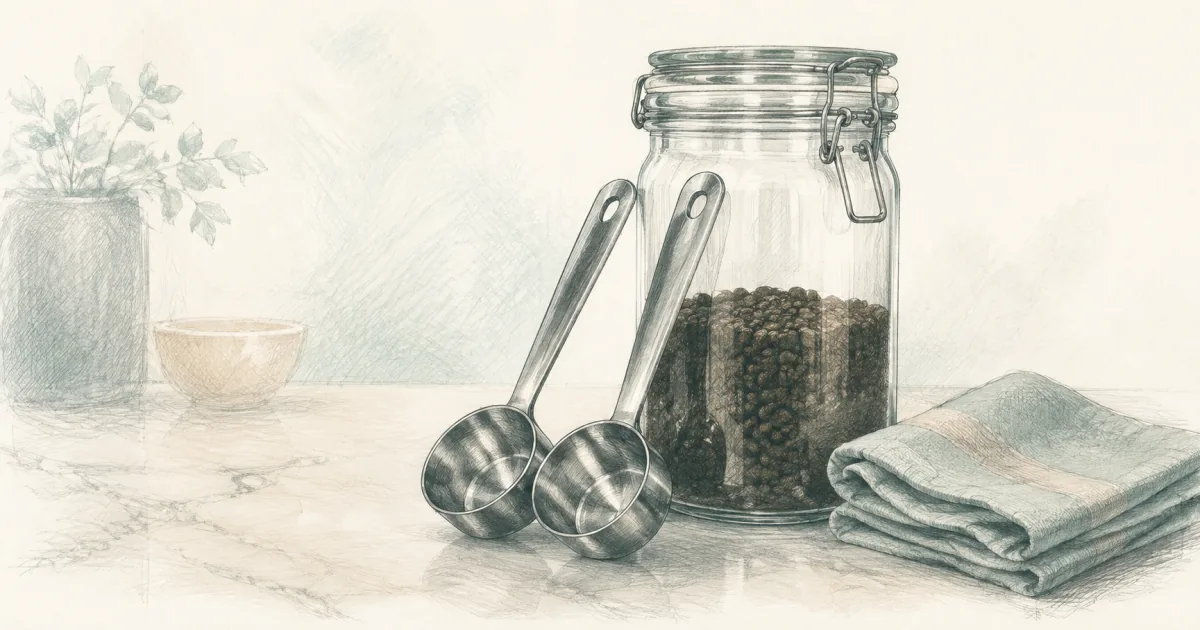
Best Coffee Scoop for Home Espresso and Pour Over
Accessories
A coffee scoop is the cheapest tool in the kit, but the right one makes a weekday dose feel effortless. Match long handle to canister depth, then decide between 1 tbsp, 7g, or a clip-on scoop that lives on the lid.
Our picks
A coffee scoop is the cheapest tool on the counter, but it gets touched more often than the grinder. The right one stays out of the sink, fits your canister, and gives a level dose without scraping knuckles.
This is not the same job as a dosing cup. A dosing cup catches grounds at the grinder for weighing before the portafilter. A scoop measures whole beans at the canister. If you weigh every shot, you might not need a scoop at all. If you scoop and brew, this is the tool that decides whether your routine feels fast or fussy.
What a coffee scoop actually does
A scoop measures whole beans by volume. A level 1 tablespoon scoop of beans weighs about 5 to 7 grams, depending on the bean. That is enough for a single shot of espresso and about half a strong cup of pour over.
A scale measures mass and removes the guesswork. For dialing in espresso, weigh every dose. For a quick weekday pour over, the scoop is honest enough.
Use a scoop if:
- You brew pour over, French press, or moka and want a level tablespoon every morning.
- You make single shots and accept a small dose variation.
- You keep beans in a deep canister and want a long handle.
Use a scale if:
- You pull espresso every morning and care about dose precision.
- You switch beans often and want to measure each one.
A coffee scoop costs less than a bag of beans. If you do not have one, get one. The trio below covers the three main buying decisions: a long-handle all-rounder, a clip-on for OXO canisters, and a calibrated espresso scoop.
Top pick: U-Taste 1 Tablespoon Coffee Scoop
The U-Taste 1 Tablespoon Coffee Scoop is the one most home bars should buy. The 18/8 stainless build handles dishwashing and years of morning scooping. The 4.3 inch handle is long enough to reach the bottom of a typical 12 ounce canister without scraping knuckles, and the flat back of the bowl scrapes a level tablespoon cleanly.
One level scoop is one tablespoon, about 5 to 7 grams of whole beans. That covers a single shot of espresso with a little to spare, or a small mug of pour over. The bowl is deep enough to avoid spillover on the way from canister to grinder.
If you brew by volume and do not want to think about grams, this is the scoop that stays out of the drawer. It is also small enough to live in a travel kit for hotel room kettles or cabin weekends.
Check price: U-Taste 1 Tablespoon Coffee Scoop on Amazon
For OXO POP canisters: OXO Good Grips POP Container Coffee Scoop
If you already store beans in an OXO POP canister, the OXO Good Grips POP Container Coffee Scoop snaps to the lid so the scoop lives right where the beans are. That solves the most common problem with cheap scoops, which is that they walk off the counter and end up in the silverware drawer.
The build matches the rest of the OXO line, the dose is one level tablespoon, and the scoop comes off the lid when you need to wash it. The handle is short, which is fine when the canister is on the counter. It is awkward with deep jars or narrow spouts.
Skip this one if you do not own OXO POP containers. The clip does not fit standard jars, and the short handle fights back against anything taller than about 6 inches.
Check price: OXO Good Grips POP Container Coffee Scoop on Amazon
For 7g espresso doses: Easyworkz Stainless Steel 7g Scoop
The Easyworkz Stainless Steel 7g Coffee Scoop is sized for a single espresso dose. The hollow handle keeps it light, the stainless build survives daily dishwashing, and the scoop is calibrated for roughly 7 grams of beans, which lands most home espresso baskets right where they need to be.
Use it on the mornings you do not want to weigh. A calibrated scoop is honest enough for a routine single shot when the bag says 18 grams in and the basket is comfortable with a little variation. It is not the right tool for dialing in a new bean or chasing a precise ratio.
Skip it if you brew pour over or French press. A 7 gram scoop is too small for a single mug, let alone a pot. The size is the point, and it only fits the espresso workflow.
Check price: Easyworkz Stainless Steel 7g Coffee Scoop on Amazon
How to choose a coffee scoop
Three things matter: handle length, bowl size, and how the scoop lives between uses.
Handle length sets how the scoop feels. A short handle works for counter-height canisters. A long handle is the only way to reach the bottom of a deep bag or tall jar without a second hand. Pick the handle that matches where you store beans.
Bowl size sets the dose. A 1 tablespoon scoop is roughly 5 to 7 grams of whole beans, which is the right size for a single espresso shot or a small pour over. A 2 tablespoon scoop covers travel mugs and batch brews. Anything smaller is closer to a measuring spoon than a coffee scoop.
How the scoop lives between uses decides if it stays useful. A loose scoop ends up in the silverware drawer. A clip-on scoop stays on the canister. A dedicated spot on the counter is the third option. Pick the workflow that matches your kitchen.
Skip mystery multi-packs that bundle scoops in sizes you will not use. Two of the same scoop in stainless is more useful than a five-size set where three sizes never leave the box.
Who should skip a coffee scoop
Skip it if you weigh every dose on a scale. A scoop only earns its place on busy mornings, travel days, and for guests who want to scoop and brew. If you already pull espresso with a 0.1 gram scale, the scoop is a backup, not a daily tool.
Skip mystery plastic scoops from random kitchen bundles. They bend, hold odors, and break within a season. The stainless picks above cost about the same as a bag of beans and last for years.
Skip it if you only buy pre-ground coffee. A spoon from the silverware drawer does the job for pre-ground, and the dedicated scoop earns its keep with whole beans that need to move from canister to grinder.
Care and longevity
Rinse the scoop under warm water after each use, especially if you ground oily espresso beans. Stainless scoops are top-rack dishwasher safe. Avoid abrasive scrub pads that dull the polished finish. Store it where it cannot fall into the sink.
If the scoop starts to bend at the handle joint, retire it. A bent scoop delivers inconsistent doses and digs into the canister. Stainless scoops rarely bend. Plastic ones do.
For more on the kit that surrounds the scoop, browse the espresso accessory guides or read the best espresso accessories pillar for the next step in the routine.
Bottom line
A coffee scoop is the cheapest tool in the kit and the one that decides whether a morning routine feels easy. The U-Taste 1 Tablespoon Coffee Scoop is the everyday pick. The OXO POP scoop is right for OXO canister owners. The Easyworkz 7g scoop is the espresso shortcut. Pick the one that matches your canister and your dose, and leave the silverware drawer alone.
More gear notes live on the Baristapicks blog and the homepage.
Frequently Asked Questions
Is a coffee scoop 1 tablespoon or 2?
Most standard coffee scoops are 1 tablespoon (about 15 ml). A 1 tablespoon scoop of whole beans weighs somewhere between 5 and 7 grams depending on bean size and roast, which works for a single shot of espresso. Two tablespoons scoops (about 30 ml) are sold for travel mugs and batch brews.
How many scoops of coffee for 12 cups?
The shorthand is 1 scoop per 6 ounce cup, so 12 cups is 12 level scoops with a standard tablespoon scoop. That assumes a roughly 1 to 16 brew ratio. Scale up or down based on how strong you want the pot.
How much coffee do I use for 8 cups of water?
With a 1 tablespoon scoop, plan on 8 scoops for 8 six ounce cups. If you weigh the dose instead, 60 to 75 grams of beans for 48 ounces of water is a starting range. Adjust by taste.
Do I need a coffee scoop if I have a scale?
No. A scale is more accurate than any scoop for dialing in espresso and pour over. The scoop earns its place on a busy morning, for travel, and for guests who just want to scoop and brew.
Can I use a regular tablespoon for coffee?
Yes, but the handle is short, the spoon is shallow, and it disappears in a drawer. A purpose-built coffee scoop has a longer handle and a deeper bowl so it reaches into canisters and levels more cleanly.
Are stainless steel coffee scoops better than plastic?
Stainless lasts longer, handles dishwashing, and does not pick up odors from old beans or spices. Plastic is fine for a backup. Avoid mystery mystery metals with no plating information.
How do I clean a coffee scoop?
Rinse under warm water after each use, especially if you ground oily beans or use the scoop for sugar and tea. Stainless scoops are dishwasher safe on the top rack.
Should the scoop match my canister?
Only if you use a clip-on style like the OXO POP scoop. Otherwise the only thing that matters is handle length. Pick a handle that reaches the bottom of your canister without scraping knuckles.