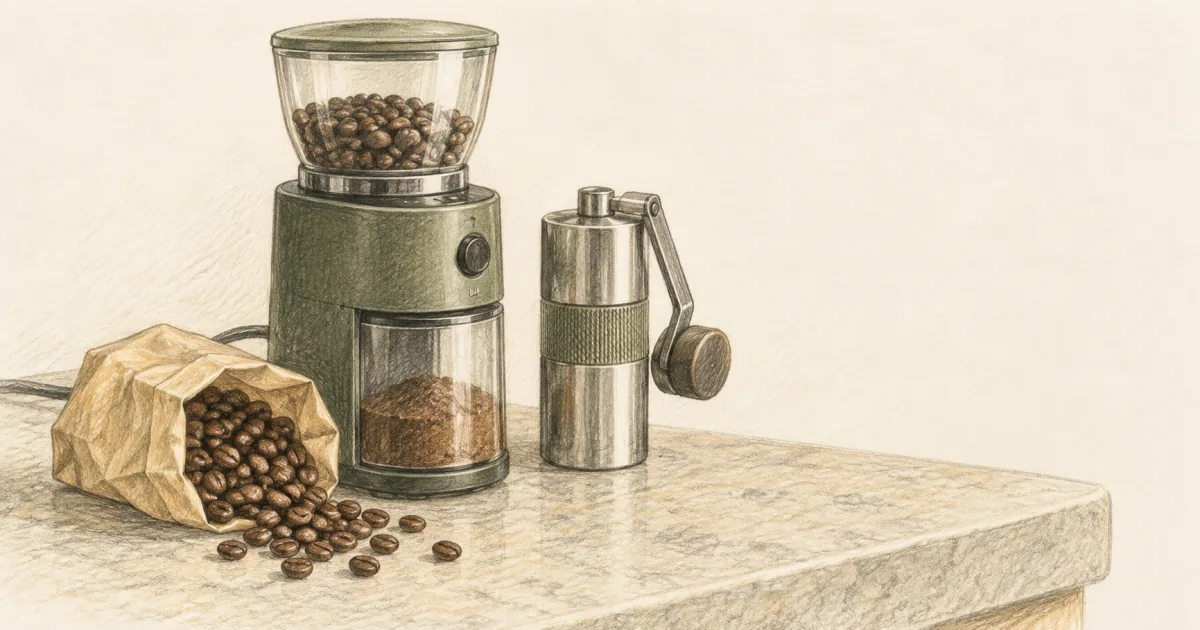
Best Burr Coffee Grinder Under $100 (2026): 3 Picks
Grinders
A burr grinder under $100 can carry drip, pour-over, and French press all week. The Ollygrin is the pick for most kitchens, the OXO Brew Compact fits small counters, and the Timemore C3 ESP Pro is the quiet hand mill.
Our picks
A real burr grinder under $100 used to mean a compromise. That has changed. A handful of budget mills now use stainless conical burrs, hold a setting between brews, and cover everything from drip to French press without a cloud of dust in the cup. What they still cannot do is chase true espresso, and that is the one limit worth understanding before you buy.
This guide is for brewed coffee: drip, pour-over, French press, moka pot, and cold brew. If shots are your main drink, our espresso burr grinder guide is the better starting point. For the wider picture on matching a mill to your brew method, start with the coffee grinder pillar. More grinder paths live under the grinder guides.
What $100 actually buys in a burr grinder
At this price you get stainless steel burrs, a stepped adjustment dial, and enough range for every brew method except true espresso. You do not get the fine, repeatable micro-steps that a real espresso dial-in needs. That is the honest dividing line.
Three things matter more than brand at this price. First, the burr set has to be metal, not a crushing disc. Second, the grinder has to hold its setting so tomorrow tastes like today. Third, cleanup has to be easy enough that you actually do it.
Capacity and noise settle the rest. A hopper that holds a full pot suits a household. A compact body or a hand mill suits one person and a small counter. Neither is better, they just fit different mornings.
Quick comparison
Shop: Ollygrin · OXO Brew Compact · Timemore C3 ESP Pro
Top pick: Ollygrin Burr Coffee Grinder
The Ollygrin Burr Coffee Grinder is the best burr coffee grinder under $100 for most kitchens because it covers the widest range of everyday brews without fuss. The 40 mm stainless conical burrs and 30 stepped settings move from fine pour-over to a genuine coarse French press, and the coarse end reaches cold brew too.
The design win is the hopper. It locks in place, so you can lift it off the base with beans still rattling around inside and set it down without a spill. The gear-reduction motor turns slowly, which keeps heat away from the oils and keeps the noise down.
The catch is the fine end. This is a brewed-coffee grinder, not an espresso mill, and the plastic grounds bin gathers static once it has some use on it. For drip, pour-over, press, and cold brew, it is a lot of grinder for the money.
Who it is for: Households that brew filter coffee all week and want one grinder that handles every method except true espresso.
Check price: Ollygrin Burr Grinder on Amazon
Best compact: OXO Brew Compact
The OXO Brew Compact Conical Burr Grinder is the pick when counter space decides. It stands 11 inches tall and 4 inches wide, small enough for a cabinet or a deep drawer, yet it still runs 15 settings with 29 micro-adjustments and stainless conical burrs.
The compact body hides a real burr set. OXO's grinders are known for consistent medium and coarse grinds, and the chuteless design makes the burr chamber easy to reach. The grounds container has a built-in spout, so pouring into a filter is tidy.
The 50 g hopper is the compromise. That is enough for about six cups, so a large batch takes two grinds. Grounds also cling to the burr assembly during teardown, and a light spritz on the beans cuts the static. If you brew a cup or two at a time, neither matters.
Who it is for: Small kitchens and one or two person households that want the grinder off the counter between uses.
Check price: OXO Brew Compact on Amazon
Best hand grinder: TIMEMORE C3 ESP Pro
The TIMEMORE Chestnut C3 ESP Pro is the best hand grinder under $100. It uses 38 mm S2C conical burrs and a finer adjustment pitch than the standard C3, so it can actually reach an espresso grind as well as filter settings.
The folding crank is the detail that makes it a keeper. It lies flush against the aluminum body, which is more compact than most rival hand mills, and the grooved body gives you grip without a rubber sleeve. There is no cord, no motor, and no static mess on the counter.
The limitation is speed. Small burrs mean a pour-over dose grinds quickly, but an espresso dose takes more than a minute by hand. If you pull several milk drinks before work, an electric is the honest choice. For one or two cups, the quiet wins.
Who it is for: Quiet kitchens, travelers, and anyone who grinds a cup at a time and wants a mill that fits in a bag.
Check price: TIMEMORE C3 ESP Pro on Amazon
How to spend your $100 well
Decide how many cups you brew at once before you compare grinders. A hopper under 60 g means two passes for a full pot. If your household drinks coffee all morning, capacity matters more than a fancy dial.
Then decide whether noise matters. A hand mill is silent and packs away, but it asks for a minute of cranking per dose. An electric is louder but a full pot takes seconds. Neither is wrong, and the price is similar.
Finally, leave a little budget for the small stuff. A cheap brush, a spare container for beans, and a scoop do more for daily coffee than another grind setting. Fresh beans and an even grind are the two things that actually change the cup.
Budget grinder traps to avoid
The biggest trap is a blade grinder in a burr grinder's clothing. If the listing shows a spinning blade and a pulse button, it chops beans into dust and chunks. Skip it no matter how good the price looks.
The second trap is a grinder with a single coarse wheel and no steps. You cannot repeat a setting, so every pot tastes different. Look for numbered settings or clicks.
The third trap is buying for espresso you do not make yet. A budget electric will not dial in a real shot, and paying for espresso features you cannot use just takes budget away from capacity and build. If shots are the goal, save for an espresso-first grinder instead.
Who should spend more instead
Spend more than $100 if you pull espresso on a standard basket, if you brew for a crowd every day, or if you single-dose light roasts and care about clarity. Those jobs want finer adjustment, lower retention, and a bigger burr set.
For filter coffee, the jump from a $40 blade grinder to any burr mill here is the big one. The jump from a $80 burr mill to a $200 one is smaller. If drip and French press are your drinks, one of the picks above will serve you for years.
Bottom line
Buy the Ollygrin Burr Coffee Grinder if you want one budget mill that covers drip, pour-over, French press, and cold brew with a hopper you can lift out full. Choose the OXO Brew Compact when counter space is tight, or the TIMEMORE C3 ESP Pro when you want quiet mornings and a mill that travels.
Then keep the burrs brushed, store beans away from light, and change one thing at a time until the cup tastes how you like it. If you are still matching a grinder to a method, the grinder pillar and the pour-over and French press guides go deeper.
Frequently Asked Questions
What is the best burr grinder under $100?
The Ollygrin Burr Coffee Grinder is the best burr grinder under $100 for most homes. Its 30 settings cover drip, pour-over, French press, and coarse cold brew, and the auto-locking hopper makes bean swaps easy. The OXO Brew Compact wins when counter space decides, and the Timemore C3 ESP Pro is the quiet hand pick.
What is the best budget burr coffee grinder?
The best budget burr grinder is the cheapest one that still uses real burrs and holds a setting. The Ollygrin and the OXO Brew Compact both do that under $100. Skip any grinder with a spinning blade, no matter how low the price, because it chops instead of crushing.
Are cheap burr grinders good?
A cheap burr grinder is good for drip, pour-over, French press, and cold brew. It is not good for chasing perfect espresso, because the fine steps are too wide to dial in a shot. For brewed coffee, even a basic burr mill beats a blade grinder by a wide margin.
Which burr grinder did America's Test Kitchen recommend?
Testing kitchens have long favored the OXO Brew line and the Baratza Encore for brewed coffee. The OXO Brew Compact is the model that fits under $100 here. Baratza now sits above this budget, so it shows up in our step-up notes rather than the picks above.
Can a $100 burr grinder grind for espresso?
Mostly no. A few hand mills under $100, including the Timemore C3 ESP Pro, can reach an espresso grind, but a budget electric usually tops out at moka pot and pressurised basket fine. If you pull real shots on a standard basket, plan for an espresso-first grinder instead.
Is a hand grinder better than a cheap electric?
A hand grinder gives you quieter mornings, a smaller footprint, and often a finer adjustment range for the same money. A cheap electric gives you speed and a hopper for a full pot. Pick the hand mill for one or two cups and the electric for a household that drinks coffee all morning.
Do I need a burr grinder for French press?
Yes, if you care about the cup. French press needs a coarse, even grind, and a blade grinder leaves powder that turns the brew muddy and gritty. Any burr grinder on this page reaches a clean coarse setting.
How long will a $100 grinder last?
With a weekly brush-out and no rocks in the hopper, most of these grinders run for years. The motor and burrs are the parts that wear, and the removable-burr designs are the easiest to keep clean. Treat the plastic bin gently and it holds up.
Is a burr grinder under $100 worth it over pre-ground coffee?
Yes, if you drink coffee most days. Freshly ground beans taste noticeably better within a week of opening the bag, and a grinder pays for itself against cafe coffee fast. If you brew only on weekends, ask a shop to grind a small bag instead.