How to Descale an Espresso Machine at Home (2026 Guide)
Espresso machines
Descaling clears mineral scale from an espresso machine water path. Use the solution your manual allows, run the full cycle, then rinse until the water runs odor-free, not just until the tank is empty.
Our picks
Learning how to descale an espresso machine is less exciting than buying beans, but it protects the parts that make your coffee possible. Minerals in tap water collect in boilers, thermoblocks, tubes, and valves. Over time, that buildup slows water flow, makes temperature less stable, and can trigger a service call. The right product and a full rinse handle it at home in under an hour.
The important word is safe. Every brand sets its own concentration, buttons, filter handling, and rinse cycles. Your machine manual is the final answer when a general guide and the manual disagree. Dual-boiler owners should expect a longer rinse because there is more water path to clear. If that extra hardware sounds worth the upkeep, our best dual boiler espresso machine guide breaks down the trade. For machine care and buying help in one place, browse the home espresso guides.
For the full range of machines, see our best espresso machine guide.
What is the difference between descaling and cleaning?
Descaling removes mineral scale from the water path. Cleaning removes coffee oils from the group head, basket, portafilter, and brew unit. They are two jobs on two schedules, and the products are not interchangeable.
Why scale and coffee oil need different products
Scale is a mineral crust that forms where hot water sits. Coffee oil is a sticky film that builds on any surface the brew touches. A detergent loosens oil. A mild acid dissolves scale. Reach for the wrong one and you either leave the minerals in place or waste a backflush on a boiler that needed acid.
Urnex Dezcal is the descaler for minerals when your manufacturer allows a universal product. Urnex Cafiza is the detergent for coffee oils on compatible parts and backflush routines. For the full detergent routine, see how to backflush an espresso machine.
Which product does which job?
If your espresso tastes stale, a clean grinder and basket may be the issue. If your machine runs slower than usual, heats unevenly, or shows a descale alert, minerals are the more likely cause. For the daily and weekly tasks around the brew group and milk wand, see how to clean an espresso machine.
Which descaler should you use?
Field notes Urnex Dezcal. In our testing, the pre-measured packet is the detail that matters: one 28 g packet into 32 oz of lukewarm water is the whole recipe, so there is no scoop to misjudge on a Sunday morning. It dissolved clear in about a minute and left no grit in the tank. The one quirk is the smell. It carries a faint citrus-cleaner edge while it works, so we open a window and plan the job for a day we are not brewing, then rinse until that smell is gone.
Urnex Dezcal is the pick for most homes because the dosing is done for you. The 28 g packet mixes with 32 oz (1 liter) of lukewarm water, which is a ratio a lot of buyers get wrong when they pour powder by eye. It is made for coffee and espresso equipment, so it is a safer bet than a random kitchen acid.
Who it is for: anyone whose machine manual permits a universal descaler and who wants a repeatable dose. Skip it if your maker sells a branded cartridge or tablet and requires it, because the warranty and the machine software may both expect that product.
Check price: Urnex Dezcal on Amazon
Do you need a separate cleaner for coffee oils?
Field notes Urnex Cafiza. We keep Cafiza for the oil side, not the mineral side. A rounded 3 g scoop in the backflush routine pulled a surprising amount of brown residue out of a group head we thought was already clean, and the first shot afterward tasted sweeter, not soapy. It needs a full rinse and a water-only flush before coffee, and the honest catch is that it will not touch the scale in your boiler at all.
Urnex Cafiza is the companion, not a replacement. It is a phosphate-free detergent that dissolves fast, and about 3 g per backflush is the working dose. It lifts the oily film that plain water and a brush leave behind, which is what turns a clean-looking group head into a fresh-tasting shot again.
Who it is for: semi-auto and super-auto owners who already backflush. Skip it if your only problem is slow flow, because a detergent will not clear scale.
Check price: Urnex Cafiza on Amazon
How is the cycle different on a thermoblock, a boiler, and a super-auto?
A thermoblock such as a Bambino-class machine heats a smaller water path. The descale program is often short, and you still need every rinse the manual lists. Leftover solution in a thin path tastes sharp in the next shot.
A boiler machine holds more water. The cycle takes longer, and you may empty a larger container under the group and steam wand. Do not stop mid-program to save time. Scale that only half-dissolves can move and clog a valve, which is a far more expensive problem than the 15 minutes you saved.
Super-automatics often count drinks and lock you into a branded cartridge or tablet. Follow that instruction. Their internal brew systems are more complex than a simple semi-auto, and a random acid mix is a bad bet. For how those machines handle day-to-day care, see our best super automatic espresso machine guide.
How do you descale a machine with no descale program?
If your machine has no descale mode, treat it like a manual job. Mix the approved solution in the tank, heat the machine to brew temperature, and run several short water-only cycles through the group into a container. Let the solution sit in the boiler for the time your manual allows, then flush and repeat with fresh water until the taste is clean.
Do not leave acid sitting in the machine overnight to "work harder." Long soaks can attack seals and gaskets. A slow, controlled pass plus a full rinse is safer than one aggressive soak. If your machine is under warranty and has no program, a quick note to the maker's support line is worth the five minutes before you pour anything in.
What do you need before you start?
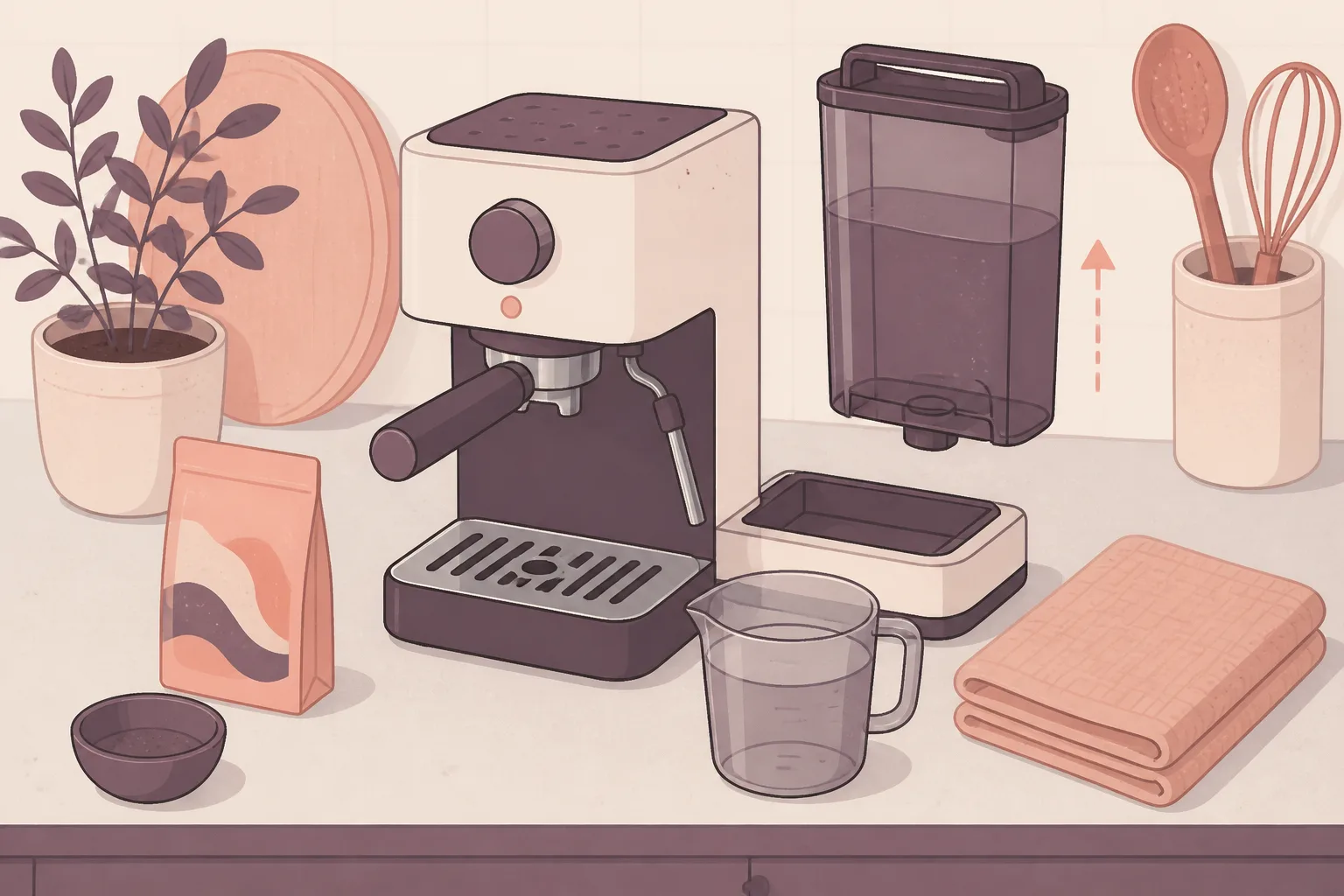
Read the manufacturer instructions before mixing anything. Have the correct descaler, fresh water, a container large enough for the full tank, and a towel for drips.
Should the water filter come out first?
On most machines, yes. Do not run a descaling solution through a filter unless the manual explicitly says to, because the acid can foul the filter media. Some machines need a bypass piece or a specific descale mode before they will begin.
Is vinegar ever okay?
Do not use a random internet recipe because it is cheaper. Strong acids can damage seals or leave an odor that takes several rinse tanks to clear. Vinegar is a poor general recommendation for the same reason, and several manufacturers warn against it directly.
What is the step-by-step process?
The exact buttons vary, but most home machines follow the same broad sequence:
- Empty the drip tray and remove the water filter if the manual says to.
- Mix the approved solution with water at the listed ratio, such as 28 g per 32 oz.
- Put a large container under the group head and hot-water outlet.
- Start the model's descale program. Do not interrupt it unless the manual tells you to refill or empty the container.
- Empty and rinse the water tank thoroughly.
- Refill with fresh water and run every required rinse cycle.
- Reinstall the filter, reset the alert if needed, and pull a water-only flush before making coffee.
The rinse matters as much as the descaler. A little leftover solution makes the first few drinks taste sharp or chemical. If you still smell the solution after the instructed rinse, run another clean-water tank. On a hard-water machine, two full rinse tanks are normal.
When is slow flow not scale?
Not every symptom is mineral. A worn grinder burr, a clogged basket, or a tired pump can all slow a shot. Here is how to tell the difference before you descale a machine that does not need it.
Common scale signs include a descale light that stays on, slower water flow than usual, more pump noise, water that runs cooler than expected, and a longer wait before the machine is ready. If those overlap, descale. If the machine flows fine and the cup is simply sour, fix the grind first.
How do you keep scale from coming back fast?
Start with your water. Very hard water builds scale faster than filtered or softer water. Your local utility may publish a hardness report, but your machine's alerts and flow behavior are more useful day to day. Small, regular maintenance beats trying to dissolve months of buildup at once.
A filter, a suitable bottled or brew water, or a shorter interval all cut the mineral load. Our third wave water for espresso guide covers brew-water basics that slow buildup. Keep the descaler near the machine rather than in a garage cabinet, so when the alert appears you act instead of postponing it for weeks.
Bottom line
Descale with the solution and ratio your manual allows, rinse until the water runs odor-free, and keep a separate detergent for coffee oils. Urnex Dezcal handles the minerals; Urnex Cafiza handles the oil. Then look at your water, because that is what decides how soon you do it again.
For more home coffee upkeep, read our espresso machine cleaning guide or browse the Baristapicks blog.
Frequently Asked Questions
How often should I descale an espresso machine?
It depends on water hardness and your machine. Many homes land between one and three months, but a water filter and the maker's descale alert can change that. Harder water means a shorter gap.
Can I use vinegar to descale an espresso machine?
Do not make vinegar the default. It can leave odor and residue, and some manufacturers specifically advise against it. A dedicated descaler such as Dezcal is mixed to a set ratio and rinses clean.
Do I remove the water filter before descaling?
Usually, yes, but follow your model's instructions. Many machines need the filter removed or bypassed for the descale cycle, and running acid through the filter can damage it.
Is descaling the same as cleaning an espresso machine?
No. Descaling targets minerals in the water system. Cleaning powder such as Cafiza targets coffee oils on compatible brew parts. One does not replace the other.
How much rinse water is enough after descaling?
Rinse until the water runs clear and odor-free, then pull a water-only flush before brewing. A little leftover solution makes the first few drinks taste sharp or chemical.
Does a thermoblock descale differently from a boiler?
The buttons differ, but the idea is the same: approved solution, full cycle, then a thorough rinse. Boilers hold more water, so the rinse takes longer, while a thin thermoblock path clears faster if you do not skip steps.
Will descaling fix sour shots?
Not if the grind or a cold machine is the cause. Descale when flow slows, heat feels uneven, or the alert is on. Sour taste more often starts with beans, grind, or a dirty basket.
What descaler should I buy for home espresso?
Start with the brand your manual names. If it allows a universal descaler, a packet product like Urnex Dezcal is a common home choice. Keep Urnex Cafiza for coffee-oil cleaning, not minerals.