Best Coffee Grinder for Moka Pot (2026): The Right Grind, Three Picks
Grinders
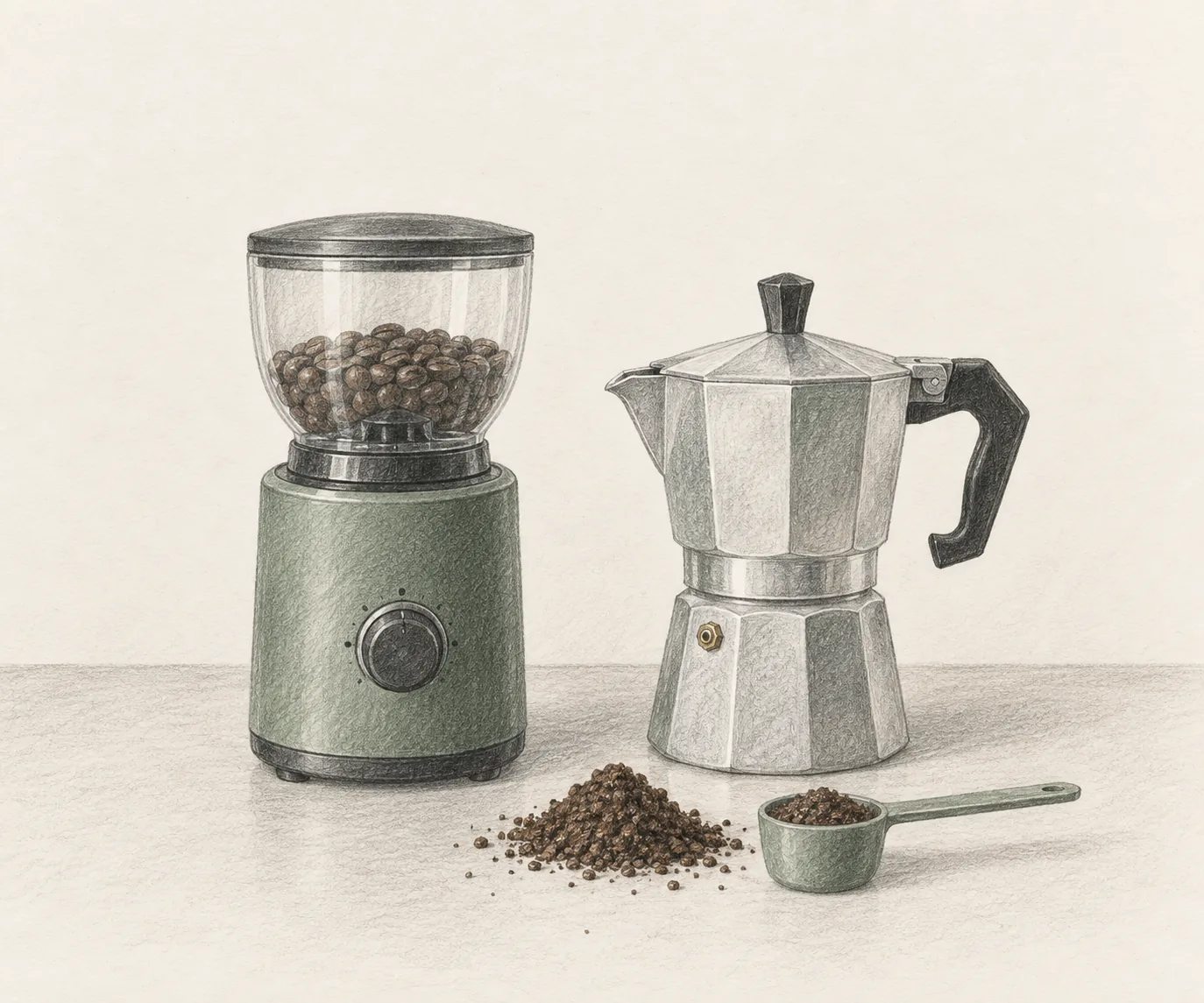
The best coffee grinder for a moka pot is the Ollygrin Burr for most kitchens, with the OXO Brew Conical Burr as the step-up and the CEVING Mini for a hand grinder that travels.
Our picks
The best coffee grinder for a moka pot is the one that can hold a fine-but-not-espresso grind without drifting. Moka coffee lives in a narrow band. Too coarse and the water races through, leaving a thin cup. Too fine and the pot sputters, chokes, and turns bitter.
That band is the whole reason a moka pot deserves its own grinder advice. A grinder set up only for drip will be too coarse, and one set for espresso will be too fine. You want something in the middle that you can return to on purpose.
These grinders sit alongside the grinder buying guides and the main best coffee grinder roundup. If you also brew filter coffee, our picks for pour-over and French press overlap with these on purpose.
What a moka pot asks of a grinder
A repeatable fine setting. Moka wants fine sand. You need a grinder whose marks you can return to, not one where every batch is a new guess.
Even particles. A spread of dust and boulders is why moka coffee tastes both sour and bitter at once. Conical burrs fix that. Blades do not.
Enough range above espresso. The grinder should go a little coarser when a pot runs hot or a bean is dense, without losing the fine end entirely.
Simple daily use. You are grinding one basket, probably before coffee. A one-touch timer or a short hand crank beats a menu.
Easy cleaning. Oily grounds build up in any grinder. A removable burr and a bin that empties cleanly keep it working.
Quick comparison
Shop: Ollygrin Burr · OXO Brew Conical Burr · CEVING Mini
Top pick: Ollygrin Burr
The Ollygrin Burr is the best coffee grinder for a moka pot for most kitchens. Thirty grind settings cover moka and French press, and its gear-reduction motor turns slowly, so the grounds stay cool and the aroma holds up. A 4.5-star average across more than 1,600 buyer reviews says most people keep using it.
The auto-locking hopper is the feature we liked most. You can lift it out with beans in it to change coffee without dumping anything, which is rare at this price. The upper burr lifts out for cleaning, and a brush is included.
The drawbacks are the usual budget ones. The body is plastic, and static builds in the grounds cup as it ages. Purge a gram or two before your main dose, and it grinds a clean, even basket for moka.
Who it is for: A kitchen that wants an electric burr grinder for moka without paying much.
Check price: Ollygrin Burr on Amazon
Best step-up: OXO Brew Conical Burr
The OXO Brew Conical Burr is the grinder to step up to when you want a bigger hopper and a repeatable timer. Fifteen main settings with micro-steps between them cover moka, drip, and pour-over without guesswork.
The 40mm conical burrs are consistent in the fine-to-medium range, which is exactly where moka sits, and the borosilicate glass grounds container pours without static cling from the container itself. The upper burr lifts off without tools for cleaning.
The honest caveat is noise and retention. The motor is loud, and a couple of grams stay in the chute between sessions, so purge a little when you switch beans. Those are small costs for how reliably it repeats a moka grind.
Who it is for: Daily moka brewers who want a repeatable fine grind, a bigger hopper, and a simple timer.
Check price: OXO Brew Conical Burr on Amazon
Best hand grinder: CEVING Mini
The CEVING Mini is the pick when you want a small, quiet grinder rather than another appliance. It uses a conical ceramic burr and a 40-click external dial, so you can change grind size without taking it apart or emptying the catch cup.
For a moka pot, its fine settings work well on medium and dark roasts, and the 30g capacity covers one basket with room to spare. It breaks down into three main parts for cleaning, and the burrs take a dry brush rather than water.
The tradeoffs are honest. It is manual, so dense light roasts take effort, and the adjustment ring can move if you grip the body low. Handle it well and it grinds a moka basket cleanly for years.
Who it is for: Small kitchens, travel, and anyone who wants to dial in a grind without running a motor.
Check price: CEVING Mini on Amazon
Grind and technique for a moka pot
Start with a grind that looks like fine sand. On the Ollygrin, it is in the lower third of its range. On the OXO Brew, it is a couple of steps finer than a pour-over setting. On the CEVING, it is in the fine cluster of clicks.
Fill the basket loosely and level it. Do not tamp. Pressing the grounds down restricts the flow and is the fastest way to a bitter pot.
Use a low flame and keep the lid open for the first few seconds. When the coffee starts to flow, you want a slow, steady stream. If it erupts or sputters, the grind is too fine or the heat is too high.
If the cup tastes sour and weak, go one step finer next time. If it tastes bitter and harsh, go one step coarser. Change one thing at a time so you know what worked.
Give the pot a quick rinse and dry the gasket area after each brew. Oily grounds left in the funnel are part of why next week's cup tastes stale. The moka pot cleaning guide covers the deeper clean.
Who should skip a moka-specific grinder
Skip this if you already own a decent burr grinder that reaches a fine setting. One good burr grinder covers moka, drip, and press. You do not need a dedicated moka machine.
Skip a hand grinder if you make several pots a day or you dislike the cranking. An electric burr grinder earns its price quickly in that case.
Skip a grinder upgrade if your moka still sputters after you fix the grind and lower the heat. That points to a tired gasket or a worn valve instead. Replace those before buying more gear.
Bottom line
Buy the Ollygrin Burr as the best coffee grinder for a moka pot for most kitchens. Its 30 settings make a fine, even grind easy to repeat, and it grinds quietly for the money. Step up to the OXO Brew Conical Burr for a bigger hopper and a one-touch timer, or choose the CEVING Mini when quiet and small matter most.
Then set the pot on a low flame and let it flow slowly. For more gear, browse the grinder guides or the best coffee grinder roundup, and read the best moka pot guide for the other half of the setup.
Frequently Asked Questions
What grind size is best for a moka pot?
Aim for a fine, even grind that feels like fine sand or table salt. It is finer than drip coffee but coarser than espresso. If the pot sputters and the coffee is bitter, go a step coarser. If the brew is weak and fast, go a step finer.
What is the best coffee grinder for a moka pot?
The Ollygrin Burr is our pick for most kitchens because its 30 settings make a moka grind easy to repeat and it costs less than the alternatives. The OXO Brew Conical Burr is the step-up for a bigger hopper and a one-touch timer, and the CEVING Mini is the best hand grinder if you want something small or portable.
Can I use pre-ground coffee in a moka pot?
You can, and many Italian brands sell a "moka" grind for exactly that. The catch is freshness, because pre-ground coffee goes flat within a couple of weeks. If you buy pre-ground, choose a moka or medium-fine grind rather than an espresso grind.
Why does my moka pot sputter?
Too fine a grind, too much coffee packed into the basket, or too much heat. Start with a coarser grind and a lower flame, and do not tamp the grounds down. Let the coffee flow steadily rather than erupting.
Is a hand grinder good enough for a moka pot?
Yes. Moka does not need espresso-level precision, so a decent hand grinder with a burr works well. The CEVING Mini's 40 external steps make it easy to fine-tune, and it travels in a bag. Expect some effort if you grind dense light roasts.
How much coffee goes in a moka pot?
Fill the basket loosely to the top and level it off. Do not press it down. A 3-cup pot takes roughly 15 to 18 grams, and a 6-cup pot takes roughly 25 to 30 grams, depending on the beans and how fine you grind.
Does a blade grinder work for a moka pot?
No, and it is the main reason moka coffee tastes inconsistent. A blade chops beans into a mix of dust and chunks, so some of the bed over-extracts while the rest under-extracts. A burr grinder fixes that for not much more money.